> ## Documentation Index
> Fetch the complete documentation index at: https://docs.snapsec.co/llms.txt
> Use this file to discover all available pages before exploring further.
# Asset Catalog
> Explore, filter, and manage all discovered external assets with real-time context, signals, and exposure insights.
## Overview
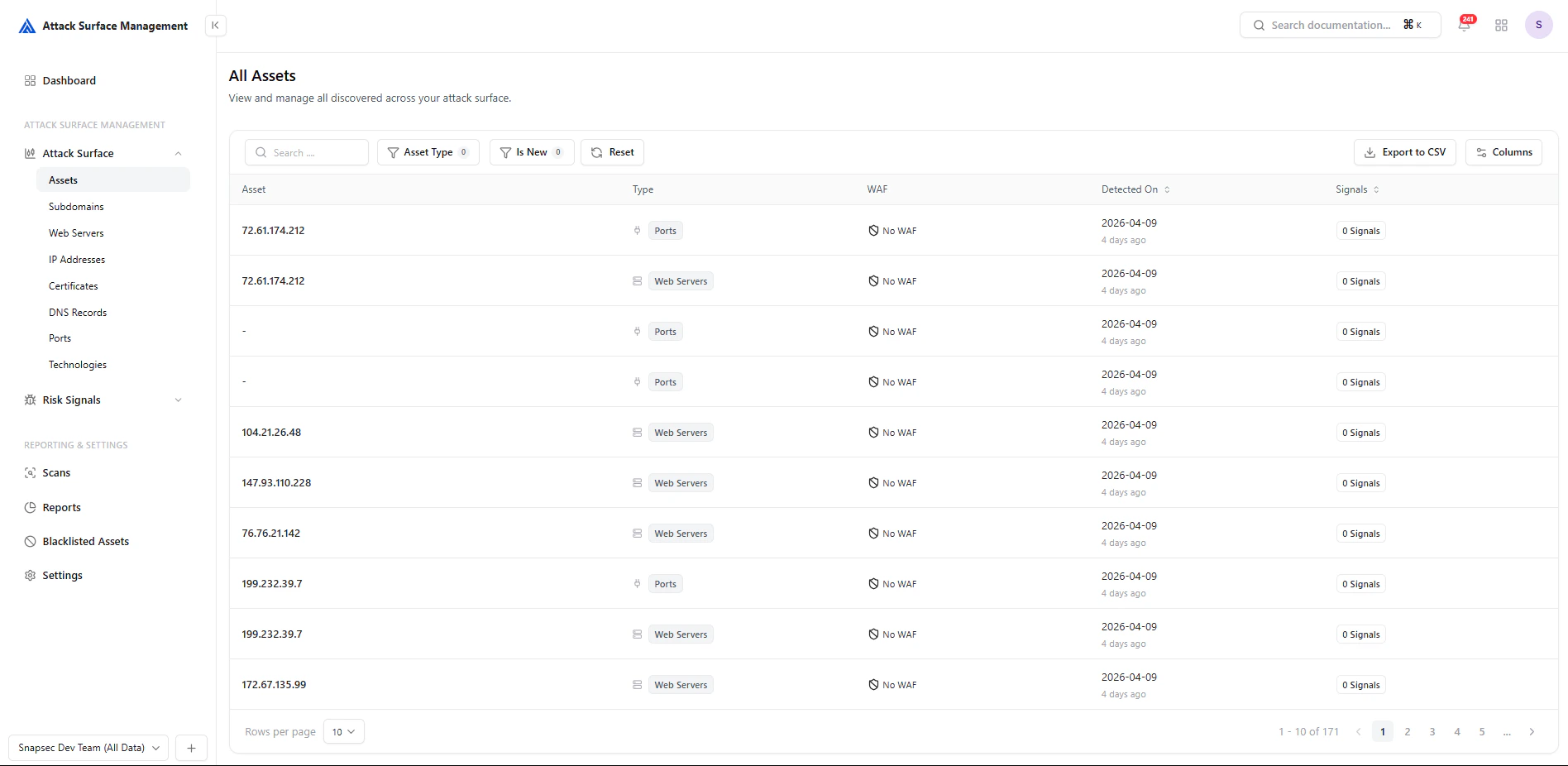
The **Asset Catalog** is your **single source of truth** for everything exposed across your external attack surface.
It provides a **structured, continuously updated inventory** of all discovered assets — enriched with context like **signals, exposure status, technologies, ports, and infrastructure mapping**.
Unlike traditional inventories, this is not just a list — it’s an **interactive system designed for investigation, filtering, and action**.
 ***
## How It Works
ASM continuously discovers and updates assets using:
* Active scanning (ports, services, web validation)
* Passive intelligence (DNS, CT logs, internet datasets)
* Technology fingerprinting
* Infrastructure mapping
Each asset is:
* **Discovered** → identified from multiple sources
* **Enriched** → tagged with metadata (WAF, ASN, tech stack)
* **Classified** → grouped by type (IP, Subdomain, Port, etc.)
* **Monitored** → updated as changes occur
* **Correlated** → linked to related entities
This creates a **live, queryable map of your attack surface**.
***
## Core Capabilities
### Unified Asset Inventory
All asset types are accessible in one place:
* Subdomains
* Web Servers
* IP Addresses
* DNS Records
* Ports
* Certificates
* Technologies
Each view is optimized for **deep inspection and filtering**, not just visibility.
***
### Filtering & Exploration
Every asset view includes powerful controls:
* Search across assets
* Filters (e.g., **Is New, WAF, Status, Network Scope**)
* Attribute-based filtering (ports, services, DNS class, etc.)
* Reset and quick refinement
This enables teams to:
* Narrow down large datasets instantly
* Investigate specific exposure patterns
* Focus on high-priority segments
***
### Signals Integration
Each asset is mapped with **signals** — indicators of potential risk, anomalies, or findings.
* Signals are visible directly in tables
* Assets with **0 signals are still tracked** (important for baseline visibility)
* Enables quick identification of **active vs clean surface areas**
***
### Export & Reporting
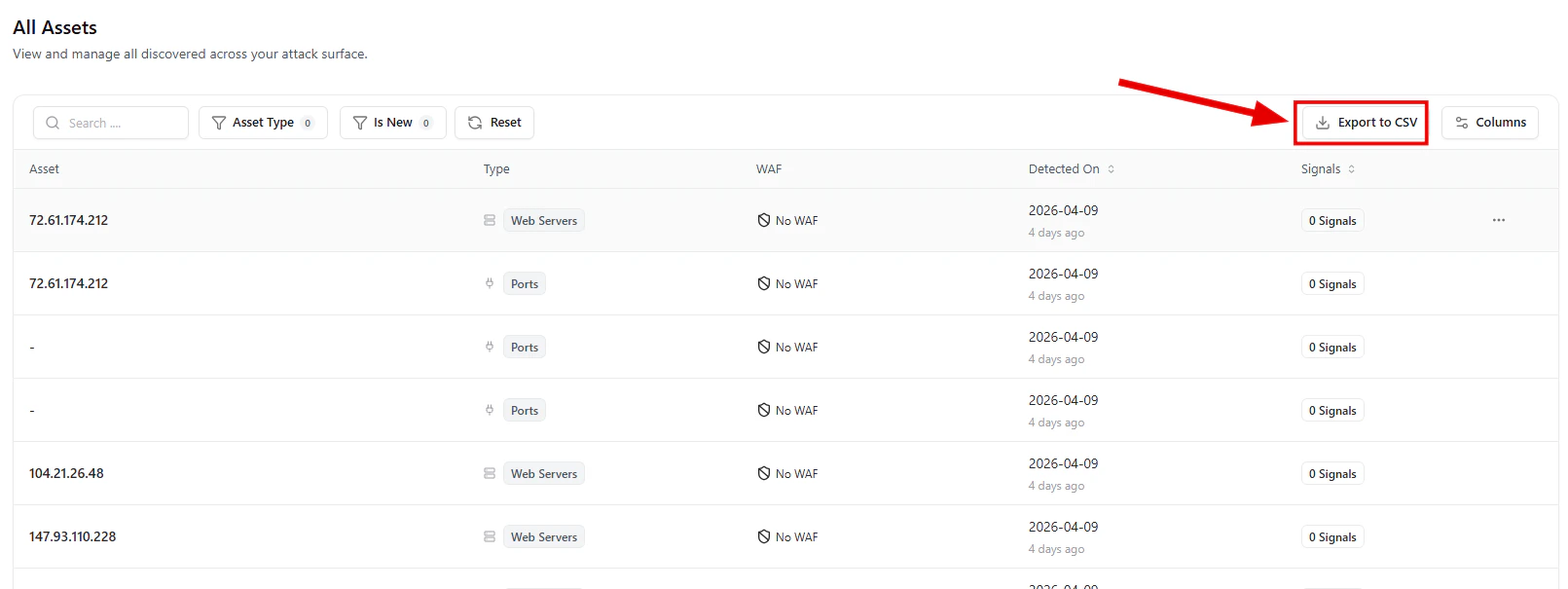
All views support **Export to CSV**, allowing teams to:
* Share data externally
* Perform offline analysis
* Integrate with reporting workflows
***
## How It Works
ASM continuously discovers and updates assets using:
* Active scanning (ports, services, web validation)
* Passive intelligence (DNS, CT logs, internet datasets)
* Technology fingerprinting
* Infrastructure mapping
Each asset is:
* **Discovered** → identified from multiple sources
* **Enriched** → tagged with metadata (WAF, ASN, tech stack)
* **Classified** → grouped by type (IP, Subdomain, Port, etc.)
* **Monitored** → updated as changes occur
* **Correlated** → linked to related entities
This creates a **live, queryable map of your attack surface**.
***
## Core Capabilities
### Unified Asset Inventory
All asset types are accessible in one place:
* Subdomains
* Web Servers
* IP Addresses
* DNS Records
* Ports
* Certificates
* Technologies
Each view is optimized for **deep inspection and filtering**, not just visibility.
***
### Filtering & Exploration
Every asset view includes powerful controls:
* Search across assets
* Filters (e.g., **Is New, WAF, Status, Network Scope**)
* Attribute-based filtering (ports, services, DNS class, etc.)
* Reset and quick refinement
This enables teams to:
* Narrow down large datasets instantly
* Investigate specific exposure patterns
* Focus on high-priority segments
***
### Signals Integration
Each asset is mapped with **signals** — indicators of potential risk, anomalies, or findings.
* Signals are visible directly in tables
* Assets with **0 signals are still tracked** (important for baseline visibility)
* Enables quick identification of **active vs clean surface areas**
***
### Export & Reporting
All views support **Export to CSV**, allowing teams to:
* Share data externally
* Perform offline analysis
* Integrate with reporting workflows
 ***
## Asset Views
Each asset type provides a focused lens into a specific layer of your attack surface.
***
### Subdomains
Subdomains represent your **external entry points**.
***
## Asset Views
Each asset type provides a focused lens into a specific layer of your attack surface.
***
### Subdomains
Subdomains represent your **external entry points**.
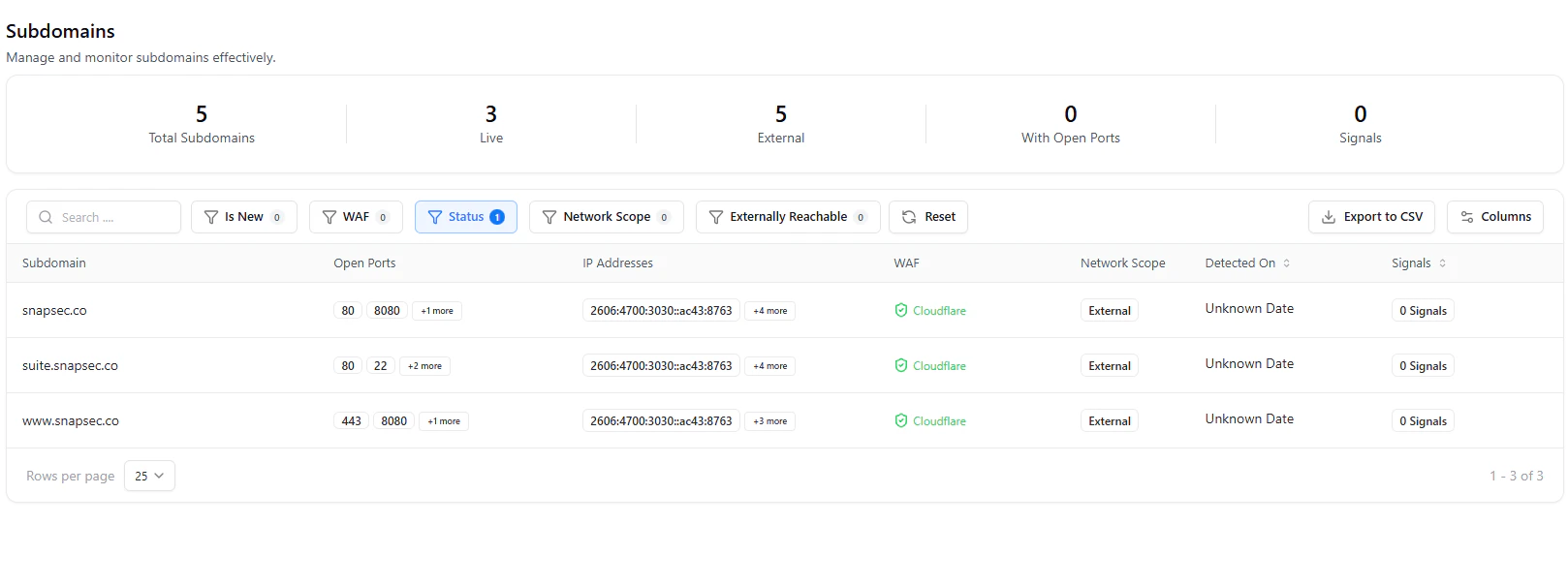 **Key Insights:**
* Open ports per subdomain
* IP address mappings
* WAF detection (e.g., Cloudflare)
* External exposure classification
* Signal presence
**Why It Matters:**\
Unmanaged or forgotten subdomains are one of the most common attack vectors.
***
### Web Servers
Focuses on **HTTP/HTTPS services and application exposure**.
**Key Insights:**
* Open ports per subdomain
* IP address mappings
* WAF detection (e.g., Cloudflare)
* External exposure classification
* Signal presence
**Why It Matters:**\
Unmanaged or forgotten subdomains are one of the most common attack vectors.
***
### Web Servers
Focuses on **HTTP/HTTPS services and application exposure**.
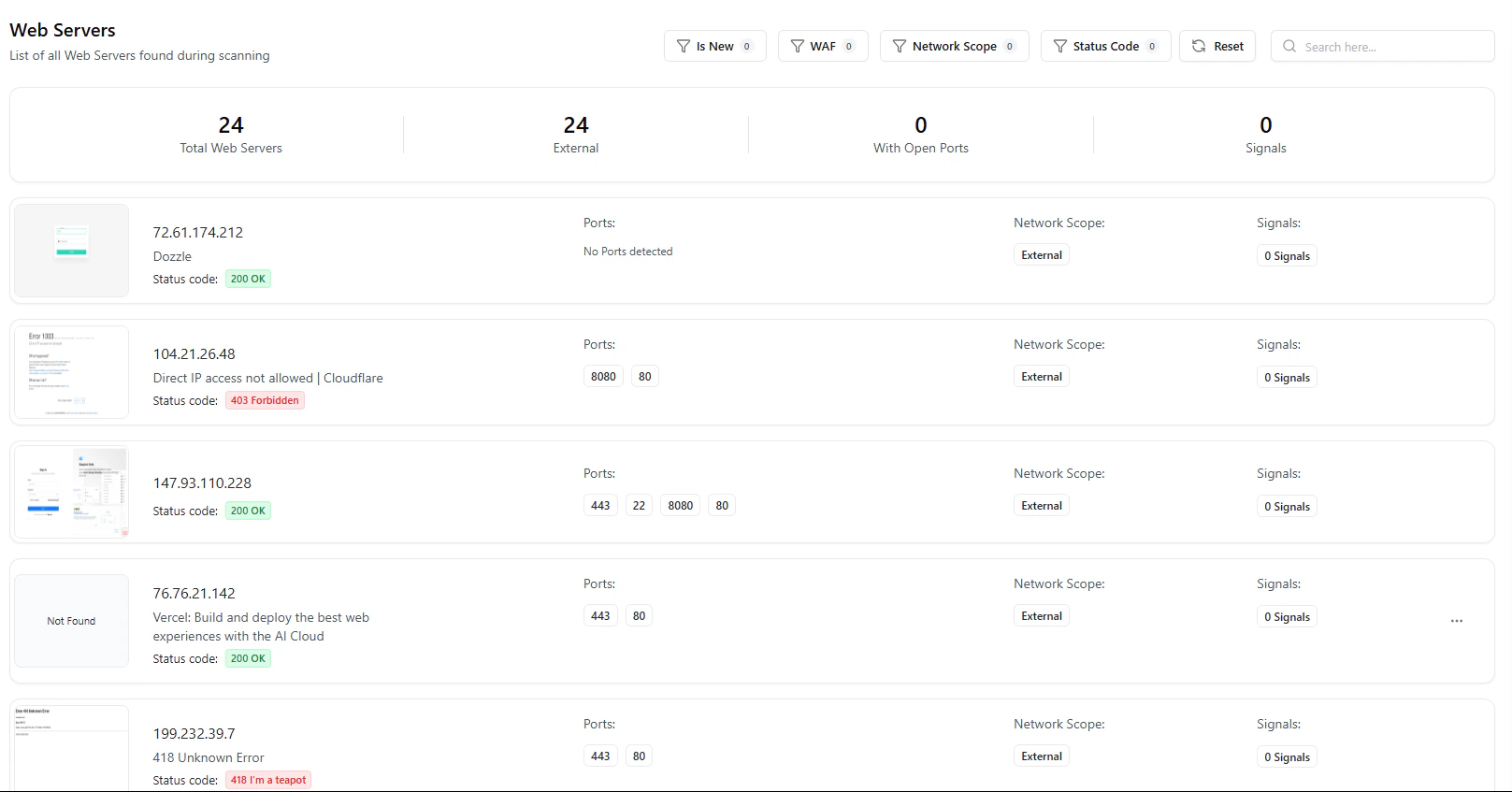 **Key Insights:**
* HTTP status codes (200, 403, 418, etc.)
* Detected services (Dozzle, Vercel, etc.)
* Open ports per service
* External exposure visibility
**Why It Matters:**\
This is where attackers interact — APIs, panels, dashboards, and apps.
***
### IP Addresses
Provides a **network-level view** of infrastructure.
**Key Insights:**
* HTTP status codes (200, 403, 418, etc.)
* Detected services (Dozzle, Vercel, etc.)
* Open ports per service
* External exposure visibility
**Why It Matters:**\
This is where attackers interact — APIs, panels, dashboards, and apps.
***
### IP Addresses
Provides a **network-level view** of infrastructure.
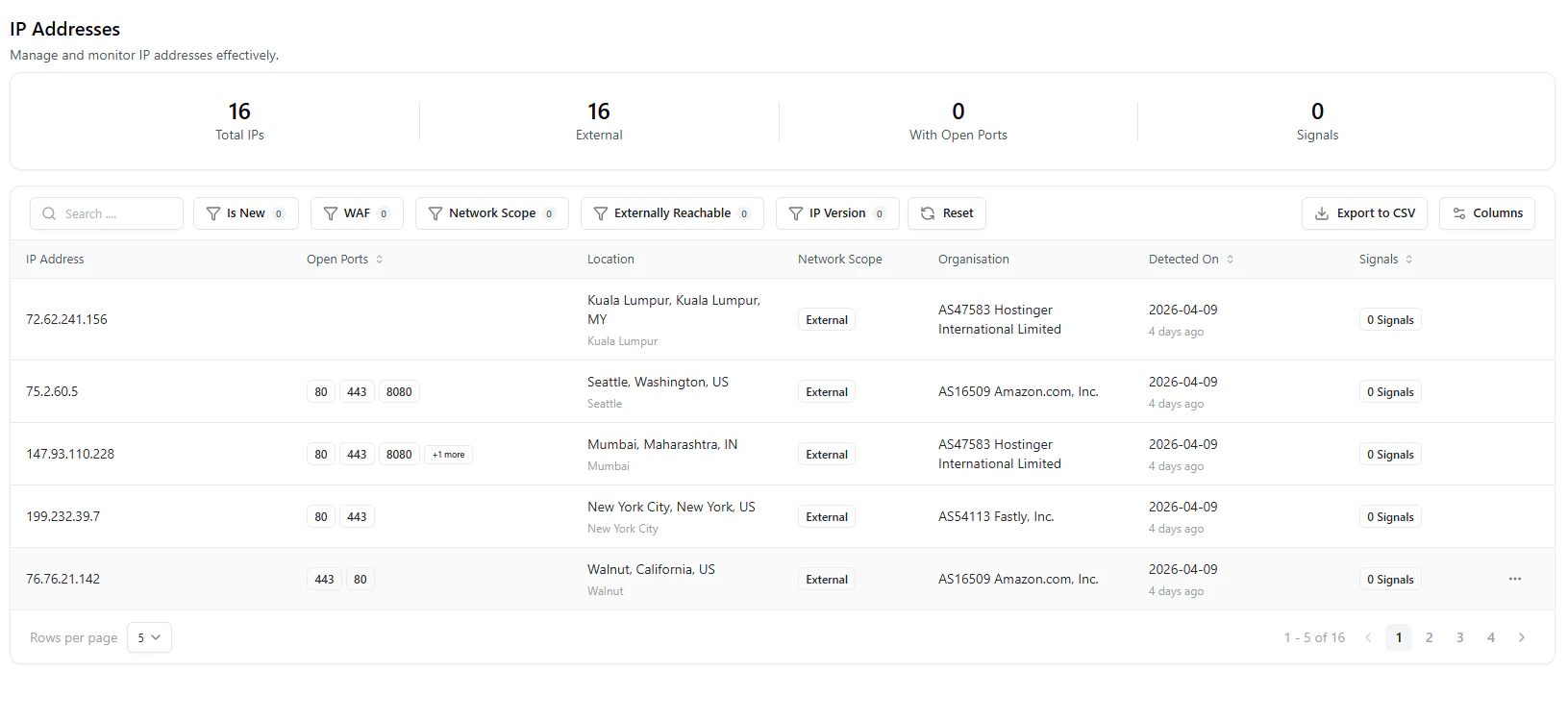 **Key Insights:**
* Geolocation and ASN (e.g., AWS, Fastly, Hostinger)
* Open ports per IP
* Network scope (external/internal)
* Infrastructure ownership
**Why It Matters:**\
Helps identify shadow infrastructure and unmanaged cloud assets.
***
### DNS Records
Tracks all DNS-level mappings and configurations.
**Key Insights:**
* Geolocation and ASN (e.g., AWS, Fastly, Hostinger)
* Open ports per IP
* Network scope (external/internal)
* Infrastructure ownership
**Why It Matters:**\
Helps identify shadow infrastructure and unmanaged cloud assets.
***
### DNS Records
Tracks all DNS-level mappings and configurations.
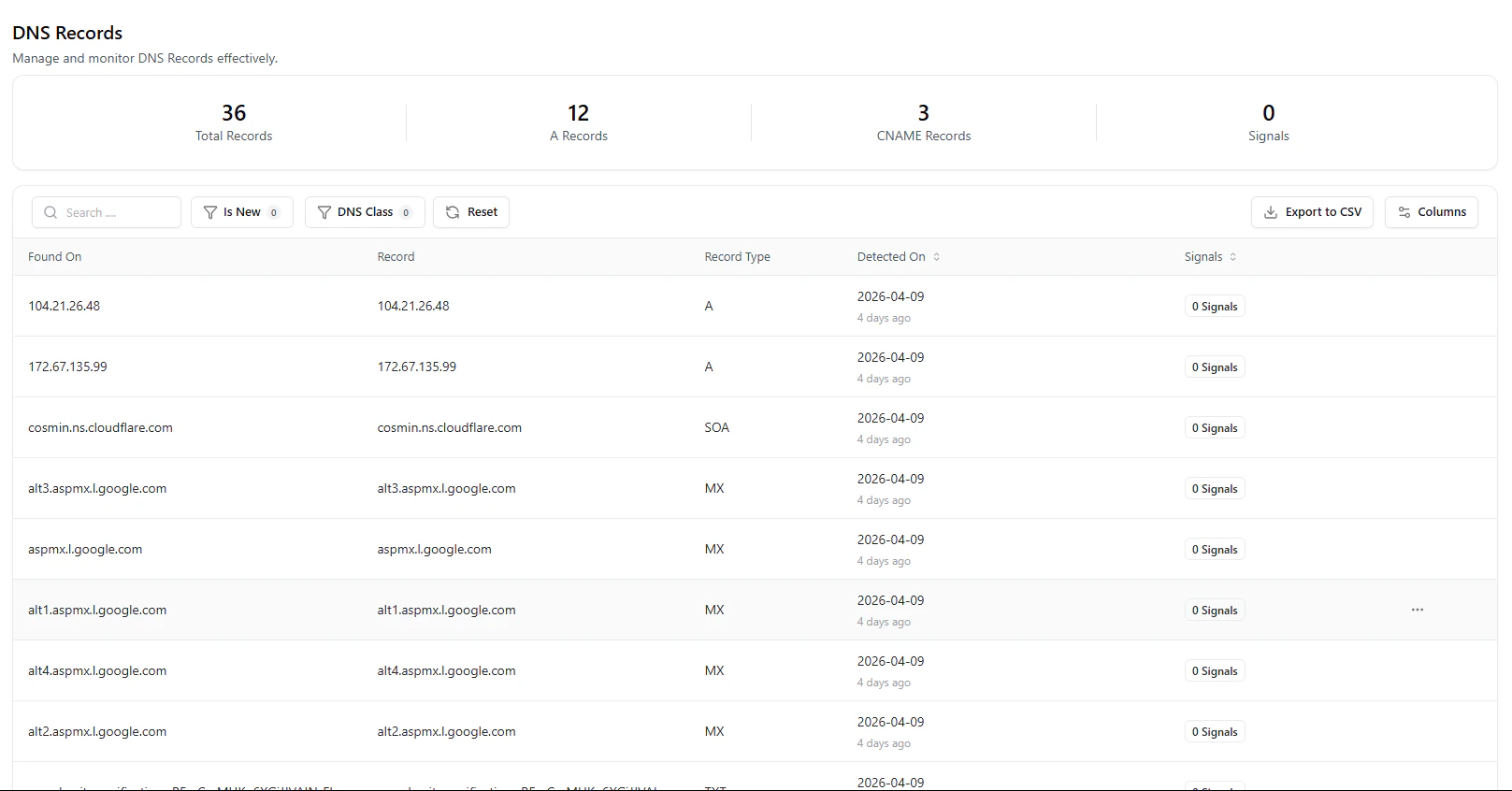 **Key Insights:**
* Record types (A, CNAME, MX, SOA, etc.)
* Domain ↔ infrastructure relationships
* Detection timestamps
* Signal tracking
**Why It Matters:**\
DNS misconfigurations and dangling records are common exposure points.
***
### Ports
Highlights **network exposure and service-level access**.
**Key Insights:**
* Record types (A, CNAME, MX, SOA, etc.)
* Domain ↔ infrastructure relationships
* Detection timestamps
* Signal tracking
**Why It Matters:**\
DNS misconfigurations and dangling records are common exposure points.
***
### Ports
Highlights **network exposure and service-level access**.
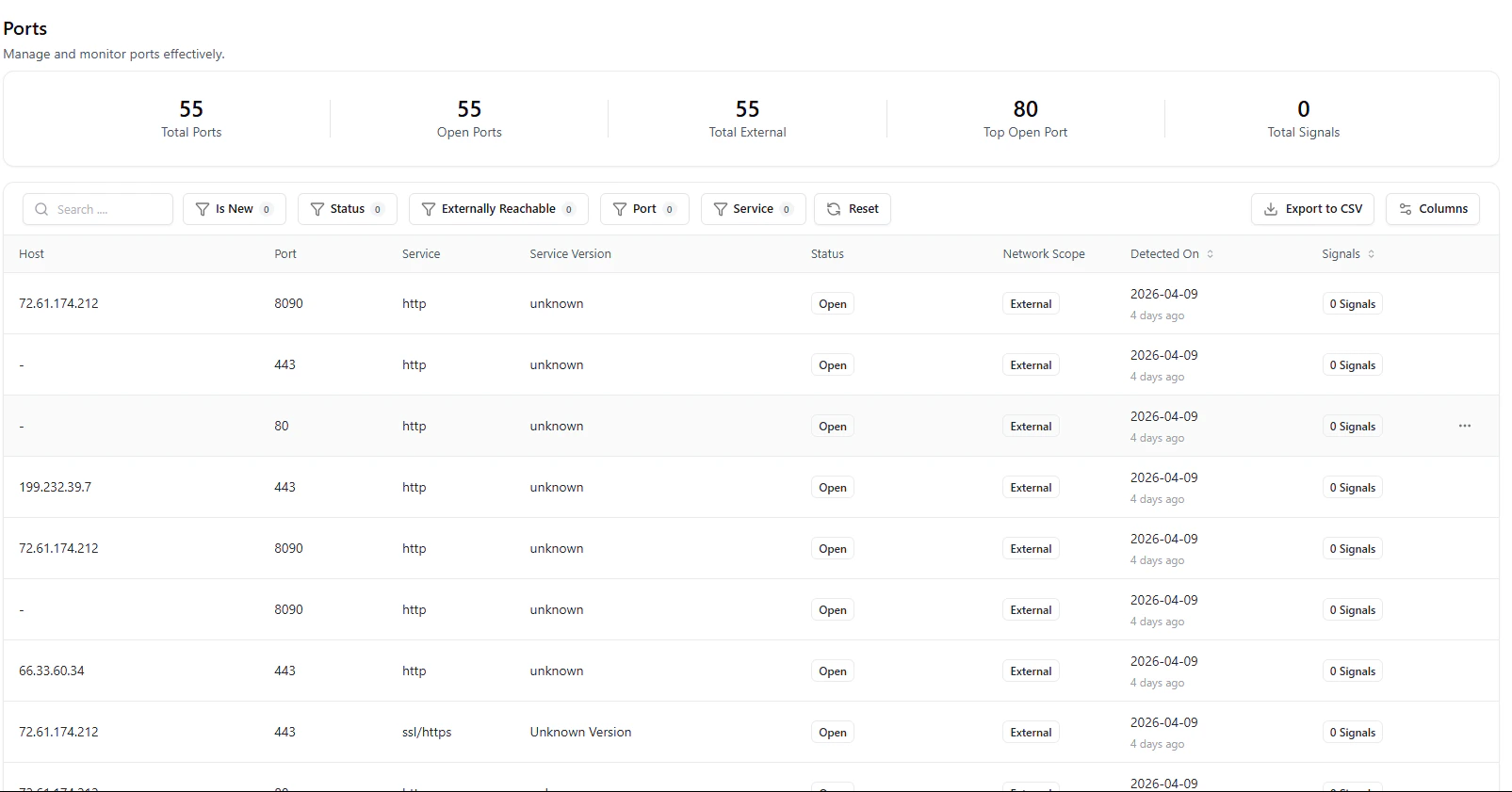 **Key Insights:**
* Open ports and services (HTTP, HTTPS, etc.)
* Service versions (if detected)
* External vs internal exposure
* Detection timestamps
**Why It Matters:**\
Unexpected open ports often indicate misconfigurations or attack surface expansion.
***
### Certificates
Tracks SSL/TLS posture across assets.
**Key Insights:**
* Open ports and services (HTTP, HTTPS, etc.)
* Service versions (if detected)
* External vs internal exposure
* Detection timestamps
**Why It Matters:**\
Unexpected open ports often indicate misconfigurations or attack surface expansion.
***
### Certificates
Tracks SSL/TLS posture across assets.
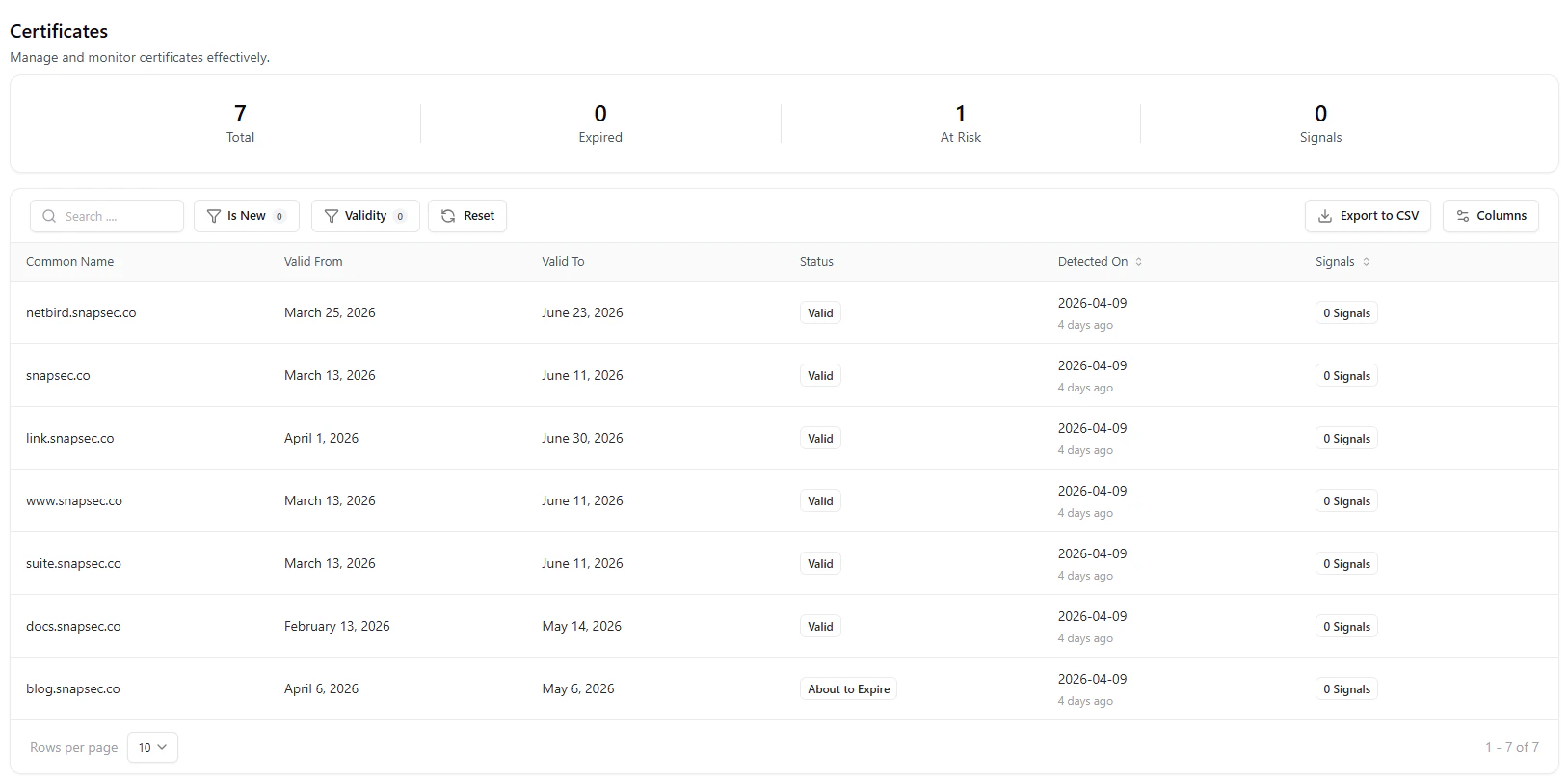 **Key Insights:**
* Valid, expired, and at-risk certificates
* Expiry timelines
* Domain associations
* Signal indicators
**Why It Matters:**\
Certificate issues can indicate neglected assets or cause service disruptions.
***
### Technologies
Provides a **high-level inventory of detected technologies**.
**Key Insights:**
* Valid, expired, and at-risk certificates
* Expiry timelines
* Domain associations
* Signal indicators
**Why It Matters:**\
Certificate issues can indicate neglected assets or cause service disruptions.
***
### Technologies
Provides a **high-level inventory of detected technologies**.
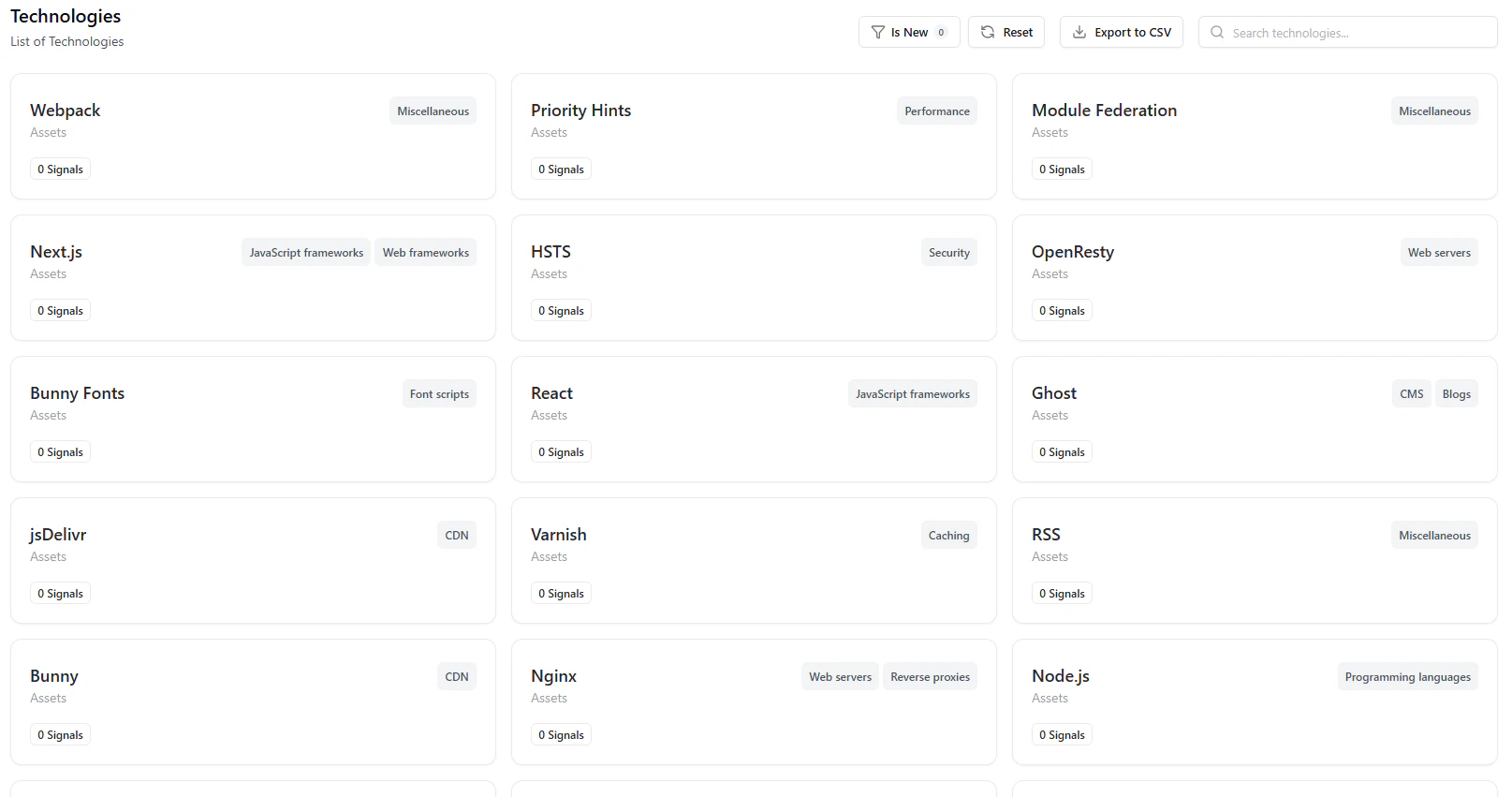 **Key Insights:**
* Frameworks (React, Next.js)
* Infrastructure (Nginx, Cloudflare, Netlify, Vercel)
* Categories (CDN, Analytics, Security, etc.)
* Asset-level mapping
**Why It Matters:**
* Detect outdated or vulnerable stacks
* Identify unauthorized technologies
* Understand platform usage across teams
***
## Correlation Across Assets
The real power of the catalog lies in **relationships**:
* Subdomain → IP → Ports → Web Server
* DNS → Infrastructure → Exposure
* Technology → Service → Risk signals
This allows teams to:
* Trace issues across layers
* Perform faster root cause analysis
* Understand full exposure context
***
## Continuous Updates
The catalog is **always live**:
* New assets are discovered automatically
* Changes are reflected in near real-time
* Signals update dynamically
This ensures your visibility is always aligned with your **actual attack surface**.
***
## Why This Matters
* **Complete Visibility** — No blind spots across external assets
* **Actionable Context** — Signals + metadata in one place
* **Faster Investigations** — Correlated asset relationships
* **Operational Efficiency** — Filter, export, and act instantly
* **Reduced Risk** — Identify exposure before exploitation
***
## Explore Live Demo
Experience how ASM provides real-time asset discovery, enrichment, and visibility across your entire attack surface.
**Key Insights:**
* Frameworks (React, Next.js)
* Infrastructure (Nginx, Cloudflare, Netlify, Vercel)
* Categories (CDN, Analytics, Security, etc.)
* Asset-level mapping
**Why It Matters:**
* Detect outdated or vulnerable stacks
* Identify unauthorized technologies
* Understand platform usage across teams
***
## Correlation Across Assets
The real power of the catalog lies in **relationships**:
* Subdomain → IP → Ports → Web Server
* DNS → Infrastructure → Exposure
* Technology → Service → Risk signals
This allows teams to:
* Trace issues across layers
* Perform faster root cause analysis
* Understand full exposure context
***
## Continuous Updates
The catalog is **always live**:
* New assets are discovered automatically
* Changes are reflected in near real-time
* Signals update dynamically
This ensures your visibility is always aligned with your **actual attack surface**.
***
## Why This Matters
* **Complete Visibility** — No blind spots across external assets
* **Actionable Context** — Signals + metadata in one place
* **Faster Investigations** — Correlated asset relationships
* **Operational Efficiency** — Filter, export, and act instantly
* **Reduced Risk** — Identify exposure before exploitation
***
## Explore Live Demo
Experience how ASM provides real-time asset discovery, enrichment, and visibility across your entire attack surface.