> ## Documentation Index
> Fetch the complete documentation index at: https://docs.snapsec.co/llms.txt
> Use this file to discover all available pages before exploring further.
# APIs
> Discover, analyze, and investigate APIs with deep visibility into endpoints, vulnerabilities, authentication posture, and asset relationships.
## Overview
The **APIs** module provides a centralized and enriched inventory of all APIs discovered across your organization.
It combines **endpoint visibility, vulnerability data, authentication insights, and ownership context** into a single interface — enabling teams to identify exposed, risky, or unmanaged APIs quickly.
 ***
## Dashboard View
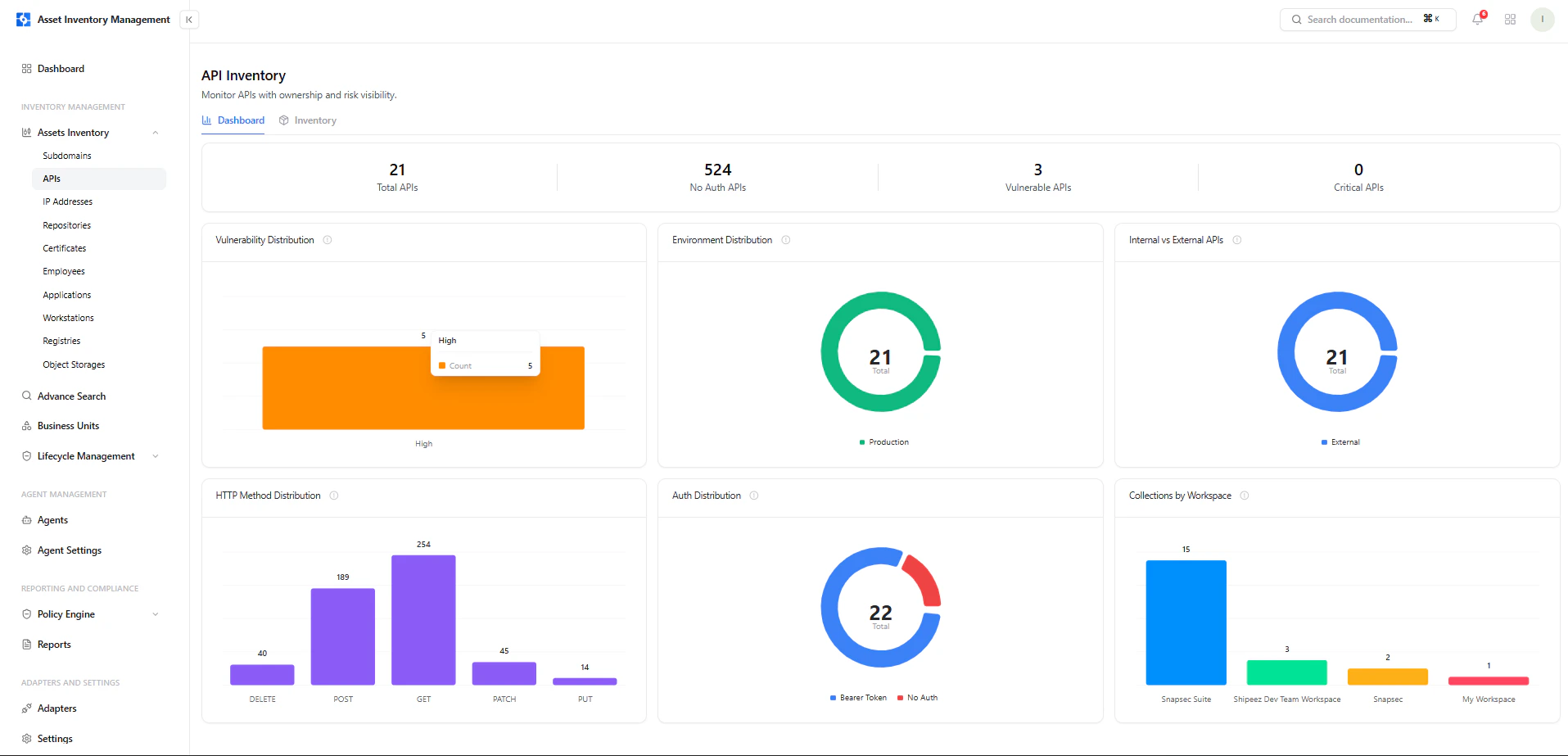
The dashboard provides a high-level understanding of API posture before diving into individual services.
***
## Dashboard View
The dashboard provides a high-level understanding of API posture before diving into individual services.
 ### Key Metrics
* **Total APIs** — All discovered APIs
* **No Auth APIs** — APIs without authentication (high risk)
* **Vulnerable APIs** — APIs with security findings
* **Critical APIs** — High severity APIs
### Visual Insights
* **Vulnerability Distribution** — Severity breakdown
* **Environment Distribution** — Production vs others
* **Internal vs External APIs** — Exposure scope
* **HTTP Method Distribution** — GET, POST, PATCH, DELETE, etc.
* **Auth Distribution** — Authenticated vs unauthenticated
* **Workspace Distribution** — API ownership across teams
***
## Inventory View
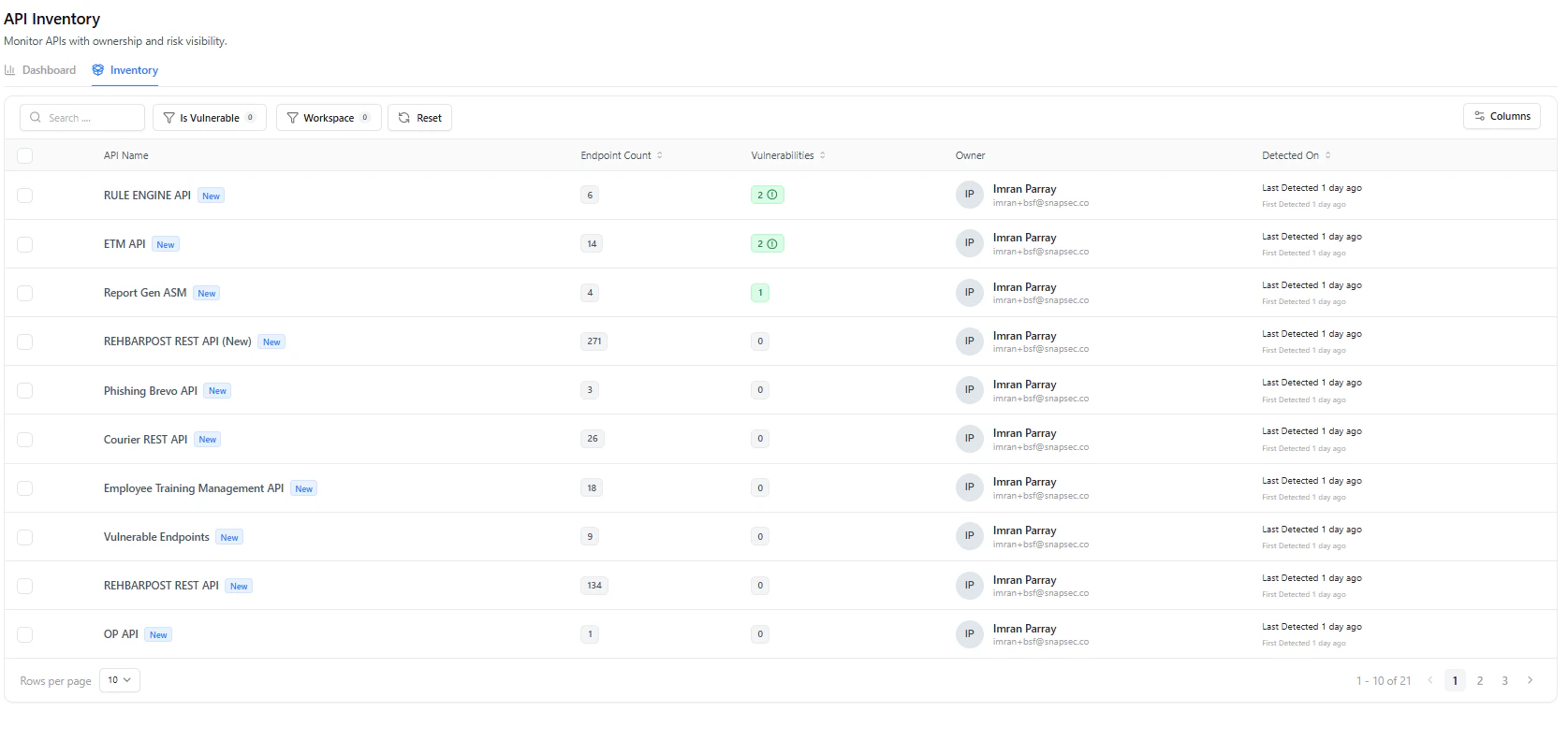
The inventory is the **operational layer** for API discovery and triage.
### Key Columns
| Column | Description |
| ------------------- | --------------------------------- |
| **API Name** | Service or API identifier |
| **Endpoint Count** | Total endpoints mapped to the API |
| **Vulnerabilities** | Number of findings |
| **Owner** | Responsible user |
| **Detected On** | First & last detection timestamps |
### Filters
* **Is Vulnerable**
* **Workspace**
* **Search by API Name**
***
## API Asset View
Clicking an API opens a **deep inspection view**.
### Key Metrics
* **Total APIs** — All discovered APIs
* **No Auth APIs** — APIs without authentication (high risk)
* **Vulnerable APIs** — APIs with security findings
* **Critical APIs** — High severity APIs
### Visual Insights
* **Vulnerability Distribution** — Severity breakdown
* **Environment Distribution** — Production vs others
* **Internal vs External APIs** — Exposure scope
* **HTTP Method Distribution** — GET, POST, PATCH, DELETE, etc.
* **Auth Distribution** — Authenticated vs unauthenticated
* **Workspace Distribution** — API ownership across teams
***
## Inventory View
The inventory is the **operational layer** for API discovery and triage.
### Key Columns
| Column | Description |
| ------------------- | --------------------------------- |
| **API Name** | Service or API identifier |
| **Endpoint Count** | Total endpoints mapped to the API |
| **Vulnerabilities** | Number of findings |
| **Owner** | Responsible user |
| **Detected On** | First & last detection timestamps |
### Filters
* **Is Vulnerable**
* **Workspace**
* **Search by API Name**
***
## API Asset View
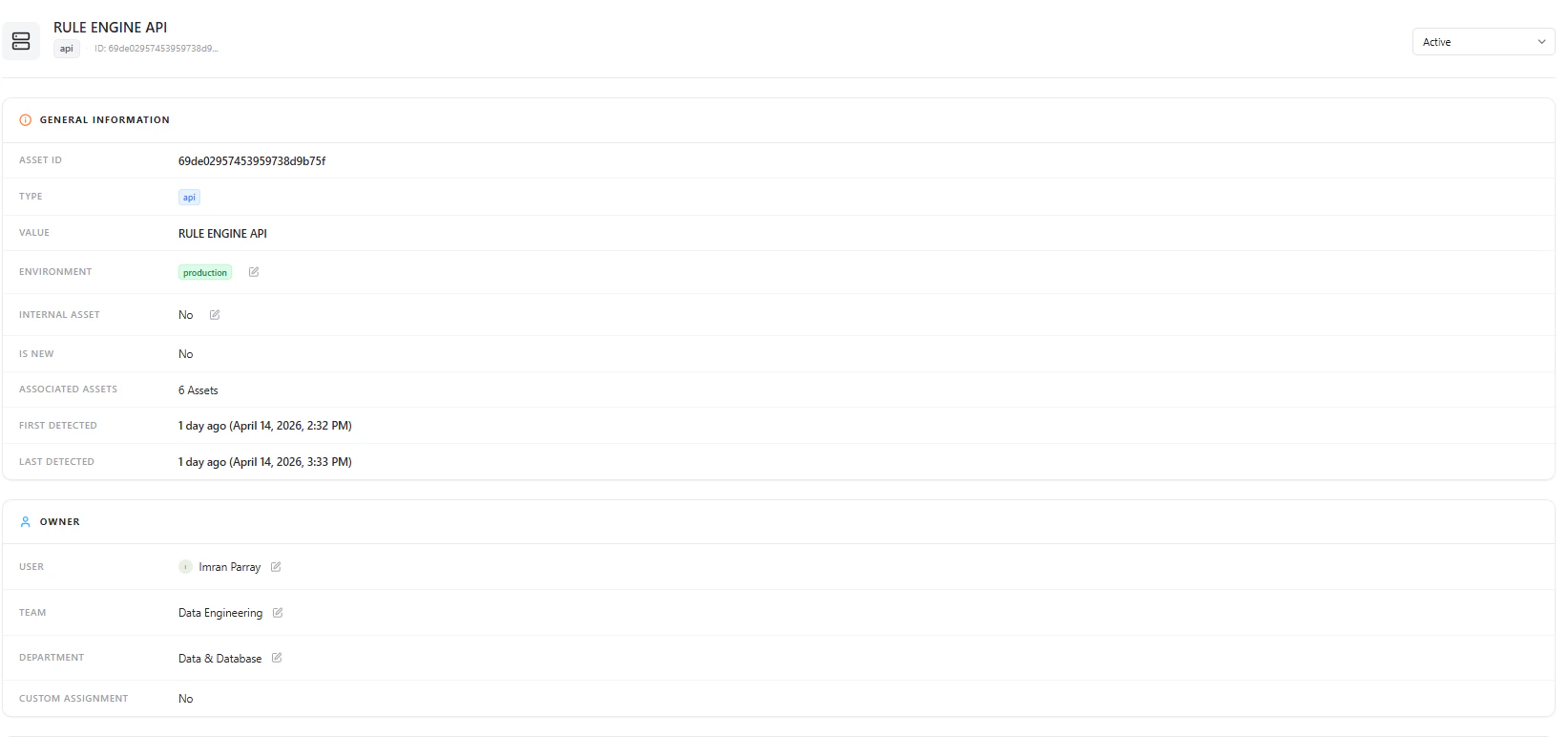
Clicking an API opens a **deep inspection view**.
 ### General Information
* **Asset ID**
* **Type (API)**
* **API Name**
* **Environment**
* **Internal Asset (Yes/No)**
* **Is New**
* **Associated Assets**
* **First / Last Detected**
### Ownership Context
* **User**
* **Team**
* **Department**
This ensures **clear accountability for every API**.
***
## Security Overview
### General Information
* **Asset ID**
* **Type (API)**
* **API Name**
* **Environment**
* **Internal Asset (Yes/No)**
* **Is New**
* **Associated Assets**
* **First / Last Detected**
### Ownership Context
* **User**
* **Team**
* **Department**
This ensures **clear accountability for every API**.
***
## Security Overview
 ### Security Data
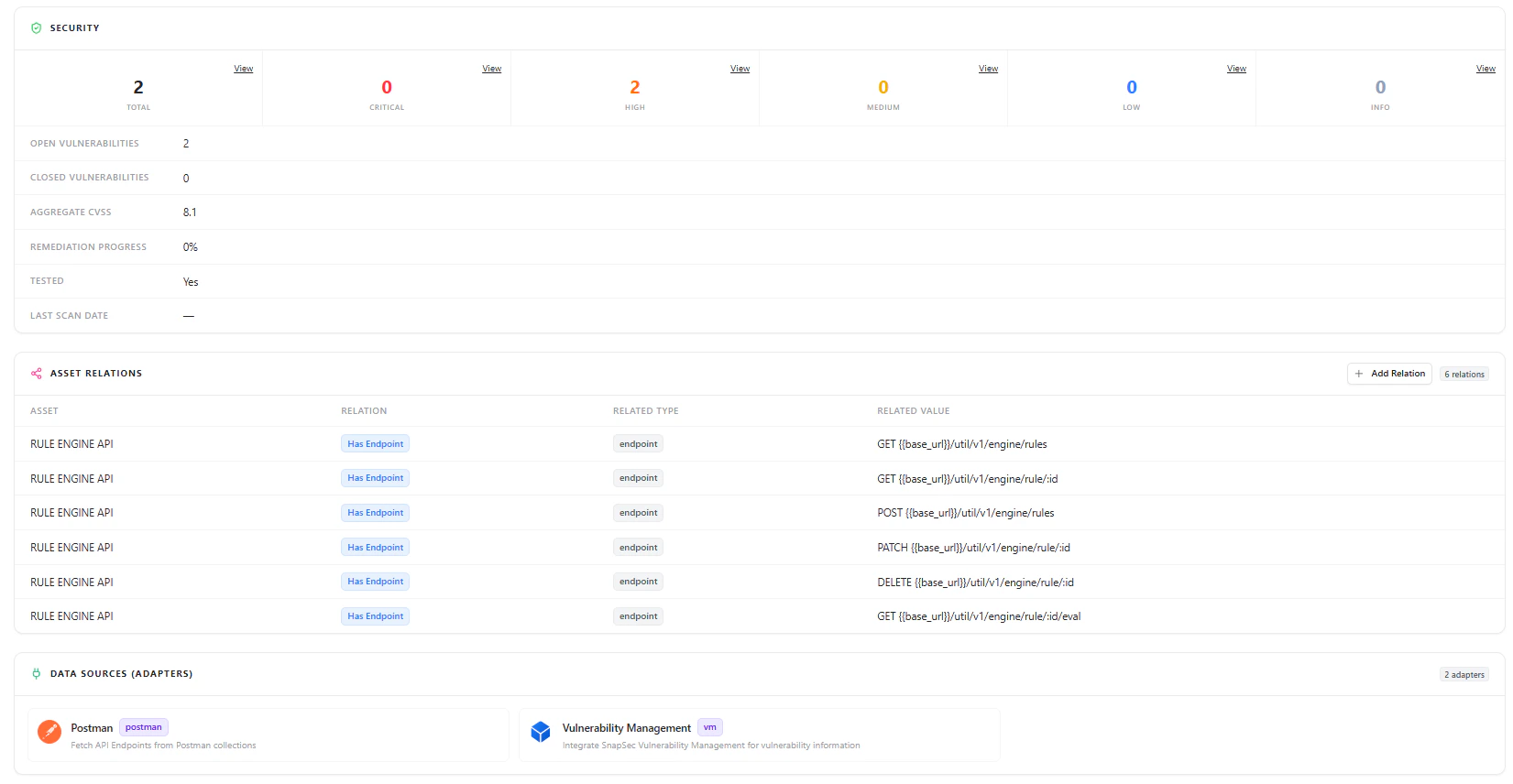
* **Total Vulnerabilities**
* **Severity Breakdown** (Critical, High, Medium, Low, Info)
* **Open vs Closed Vulnerabilities**
* **Aggregate CVSS Score**
* **Remediation Progress**
* **Test Status**
* **Last Scan Date**
***
## Endpoint Visibility
Each API is mapped to its underlying endpoints, providing **true operational visibility**.
### Endpoint Data Includes
* **HTTP Method** (GET, POST, PATCH, DELETE)
* **Endpoint Path**
* **Associated API**
* **Endpoint Type**
### Example Endpoints
| Method | Endpoint |
| ------ | ------------------------ |
| GET | /util/v1/engine/rules |
| POST | /util/v1/engine/rules |
| PATCH | /util/v1/engine/rule/:id |
| DELETE | /util/v1/engine/rule/:id |
This allows teams to:
* Understand **attack surface at endpoint level**
* Identify **sensitive or critical operations**
* Detect **overexposed APIs**
***
## Asset Relationships
APIs are not isolated — they are connected to other assets.
### Relationships Include
* **Endpoints**
* **Applications**
* **Services**
* **Other infrastructure assets**
This enables:
* **Dependency mapping**
* **Blast radius analysis**
* **Impact assessment during incidents**
***
## Data Sources (Adapters)
API data is enriched through integrations:
* **Postman** — Fetch API endpoints from collections
* **Vulnerability Management** — Attach security findings
These integrations ensure APIs are not just discovered, but **contextually enriched**.
***
## Why This Matters
The APIs module transforms API discovery into **actionable security intelligence**:
* Identify **unauthenticated APIs instantly**
* Detect **shadow or unmanaged APIs**
* Analyze **endpoint-level exposure**
* Track **vulnerabilities with real context**
* Enforce **ownership and accountability**
* Understand **API dependencies and impact**
***
## Explore Live Demo
Instantly explore how Snapsec AIM discovers, enriches, and analyzes APIs in real time — all without creating an account.
### Security Data
* **Total Vulnerabilities**
* **Severity Breakdown** (Critical, High, Medium, Low, Info)
* **Open vs Closed Vulnerabilities**
* **Aggregate CVSS Score**
* **Remediation Progress**
* **Test Status**
* **Last Scan Date**
***
## Endpoint Visibility
Each API is mapped to its underlying endpoints, providing **true operational visibility**.
### Endpoint Data Includes
* **HTTP Method** (GET, POST, PATCH, DELETE)
* **Endpoint Path**
* **Associated API**
* **Endpoint Type**
### Example Endpoints
| Method | Endpoint |
| ------ | ------------------------ |
| GET | /util/v1/engine/rules |
| POST | /util/v1/engine/rules |
| PATCH | /util/v1/engine/rule/:id |
| DELETE | /util/v1/engine/rule/:id |
This allows teams to:
* Understand **attack surface at endpoint level**
* Identify **sensitive or critical operations**
* Detect **overexposed APIs**
***
## Asset Relationships
APIs are not isolated — they are connected to other assets.
### Relationships Include
* **Endpoints**
* **Applications**
* **Services**
* **Other infrastructure assets**
This enables:
* **Dependency mapping**
* **Blast radius analysis**
* **Impact assessment during incidents**
***
## Data Sources (Adapters)
API data is enriched through integrations:
* **Postman** — Fetch API endpoints from collections
* **Vulnerability Management** — Attach security findings
These integrations ensure APIs are not just discovered, but **contextually enriched**.
***
## Why This Matters
The APIs module transforms API discovery into **actionable security intelligence**:
* Identify **unauthenticated APIs instantly**
* Detect **shadow or unmanaged APIs**
* Analyze **endpoint-level exposure**
* Track **vulnerabilities with real context**
* Enforce **ownership and accountability**
* Understand **API dependencies and impact**
***
## Explore Live Demo
Instantly explore how Snapsec AIM discovers, enriches, and analyzes APIs in real time — all without creating an account.